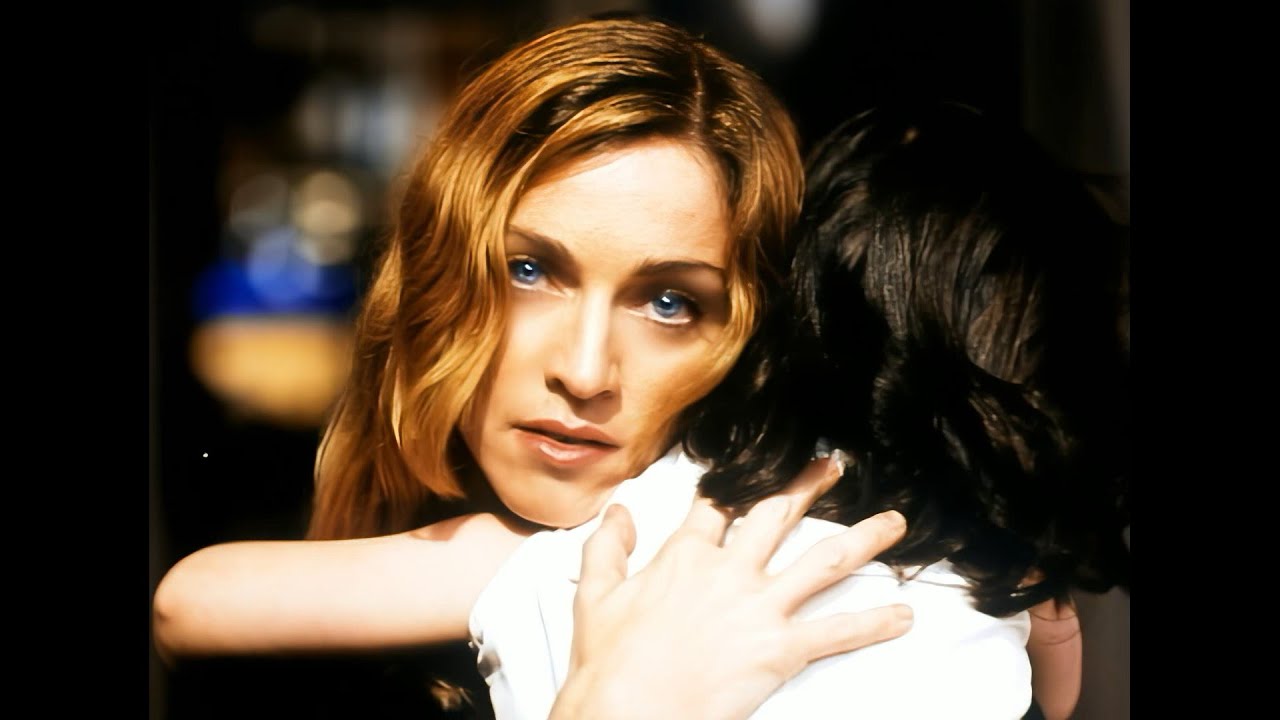
Drowned World / Substitute for Love
What fame could not replace.
“Drowned World / Substitute for Love” opens Ray of Light (1998), the album Madonna made with British producer William Orbit after the birth of her daughter. Over a slow electronic pulse she counts what fame gave her and what it cost, and arrives at a plain conclusion: none of it replaced being loved. Critics trace the title to J.G. Ballard’s 1962 novel The Drowned World. The video, shot in London by Walter Stern in June 1998, shows her pursued by photographers. Coming less than a year after the death of Diana, Princess of Wales, it set off an argument in the British press. Her spokesperson said it was about Madonna’s own life.
Official music video (YouTube, Madonna). Played in YouTube’s official player.
A tape from William Orbit
Confirmed FactThe song is the first track on Ray of Light. It was written and produced by Madonna and William Orbit, with Rod McKuen, Anita Kerr and David Collins also credited as writers.
Reported StoryThe collaboration began with a phone call. According to a 1998 feature in Keyboard magazine, Guy Oseary, Madonna’s partner at her label Maverick Records, rang Orbit, who sent over a tape of thirteen pieces of music. An early version of this track was on it. Madonna, who had admired Orbit’s work for years, liked what she heard.
Reported StoryThe same feature describes how the drums were made. A session with a drummer in Los Angeles did not work out, so Orbit had Fergus Gerrand play in London and cut the results up by hand. Orbit said they chose to keep some of the roughness of the first version.
Confirmed FactThe first sound on the album is a man’s voice saying two words. It is a sample from “Why I Follow the Tigers” by the San Sebastian Strings, a 1960s project of the poet Rod McKuen and the arranger Anita Kerr.
Reported StoryMcKuen later wrote that the credit was more than a formality: in his view the new song follows the plot line of his piece. He identified the sampled voice as the actor Jesse Pearson.
What she traded, and what she changed her mind about
InterpretationThe lyric is an inventory. She lists what a famous life contains — lovers, travel, crowded rooms, a face that everybody knows — and sets each item against the same question: was it a substitute for love? By the end the answer is no. In the closing lines she says she has changed her mind, and names what she believes in now.
Reported StoryMadonna said much the same in plain speech. In a 1998 interview with Q magazine she said that approval and popularity are no substitute for truly being loved.
Reported StoryThe title is usually traced to J.G. Ballard’s 1962 novel The Drowned World, set in a flooded, overheated London. Slant’s Sal Cinquemani makes the link, and The Guardian’s Jude Rogers has called the title Ballardian.
Unconfirmed TheoryWe have not found a statement from Madonna herself confirming the novel as her source. Treat it as a well-founded critical reading, not an established fact.
InterpretationRead that way, the image fits. A drowned world is one that was full of people and is now under water. Fame, in this song, is that flood.
London, June 1998
Confirmed FactThe video was directed by Walter Stern, the British director behind The Verve’s “Bitter Sweet Symphony” and Massive Attack’s “Teardrop”.
Reported StoryIt was filmed in London on June 26 and 27, 1998, and premiered in Europe on July 25. Most accounts place the shoot at Claridge’s hotel and Piccadilly Circus; some name the Savoy instead. We have not been able to confirm the hotel from a primary source.
InterpretationThe story is a single day. She leaves a house and is met by camera flashes. Photographers follow her car on motorbikes. In a hotel, the faces around her stretch and blur while hers stays clear; even a maid takes a picture. She runs home, and a child runs to her.
Reported StoryBefore it had even aired, British newspapers reported the motorbike scenes and compared them to the events surrounding the death of Diana, Princess of Wales. Madonna’s publicist Liz Rosenberg rejected the comparison. She said the video had nothing to do with Diana and described it as a day in the life of Madonna.
Confirmed FactThe dates explain the reaction. Diana died in Paris on August 31, 1997, after her car was pursued by photographers. This video was shot in London ten months later.
InterpretationThe echo was unavoidable, whether or not it was intended. But the video is not a re-enactment. There is no crash, and the woman on screen is a singer who had herself been photographed daily for fifteen years. It is more accurate to say that the video and the tragedy belong to the same moment in media culture.
Unconfirmed TheoryThe video does not identify the child in the final scene, and we have found no reliable source that does. She should not be assumed to be Madonna’s own daughter, Lourdes, who was not yet two years old when it was filmed.
After Evita, after Lourdes
Confirmed FactMadonna’s daughter Lourdes was born in October 1996, about two months before the film Evita opened. Ray of Light was her first studio album after both.
Reported StoryAccounts of the period describe a turn toward Kabbalah and Eastern spirituality, and the album has often been read as a record about leaving old personas behind.
Confirmed FactThe single was released in the summer of 1998 outside North America. Most discographies give August 24; Madonna’s official site lists September 15. It reached No. 10 in the United Kingdom and No. 1 in Spain.
Confirmed FactShe named her 2001 world tour after the song and opened each show with it. She returned to it on the Confessions Tour in 2006.
Three things to listen for
- 1The first second. A stranger’s voice, lifted from a 1960s spoken-word record, starts the album before she does.
- 2The drums. They arrive late and never quite settle, cut by hand from a live player.
- 3The final lines. No big finish: she states what she believes in now, quietly, and the track ends.
These links open the official track pages on Spotify and Apple Music.
- checked 2026-11-17
- checked 2026-11-17
- checked 2026-11-17
- checked 2026-11-17
- checked 2026-11-17
- checked 2026-11-17
- checked 2026-11-17
- checked 2026-11-17
- checked 2026-11-17
- checked 2026-11-17
- Q magazine (March 1998) — interview by Danny Eccleston *checked 2026-11-17
* Cited through a secondary source; we have not read the original ourselves.