Beautiful Day
A man who has lost everything looks up at the sky.
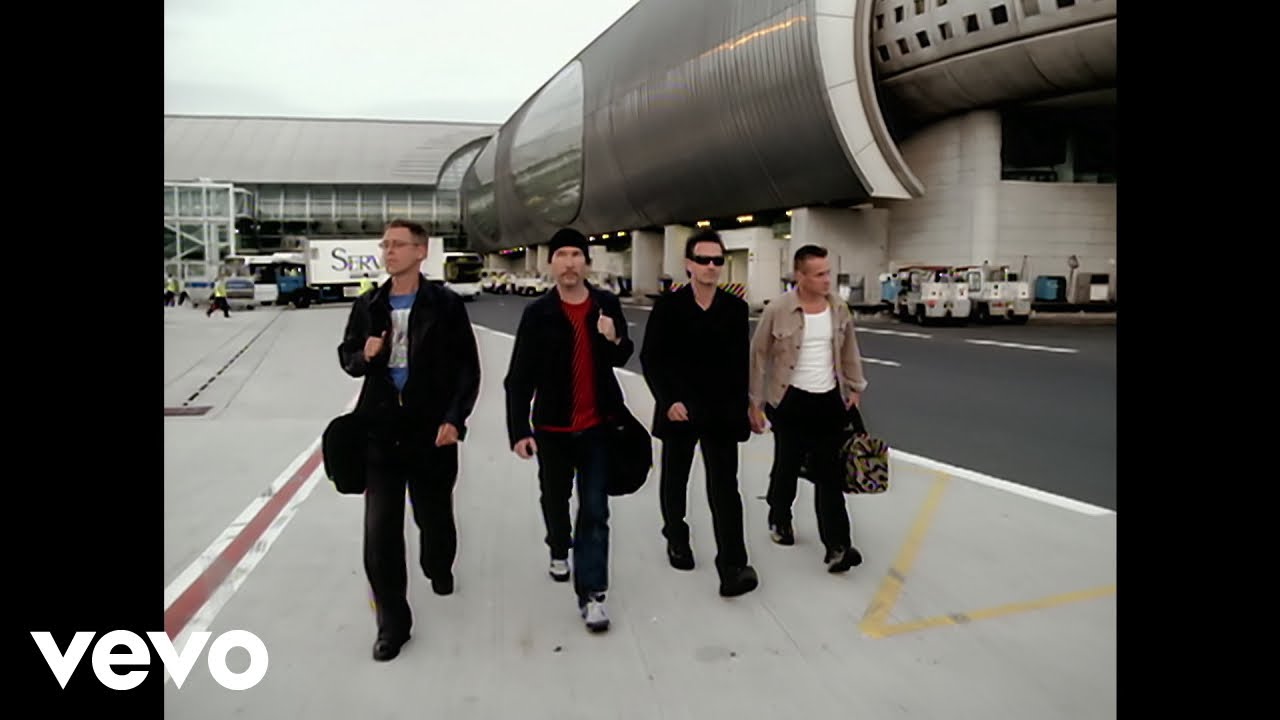
“Beautiful Day” opens U2’s 2000 album All That You Can’t Leave Behind, and it was the record’s first single. After a decade of electronics, irony and reinvention, it is the sound of a band deliberately choosing to sound like itself again. The chorus arrived by accident: Bono sang it off the cuff at the end of a long jam in Dublin, and the producers built the song around it. Its central figure has lost his home and his partner, and still calls the day beautiful. The video was shot in August 2000 by Swedish director Jonas Åkerlund at Paris’s Charles de Gaulle Airport — less than three weeks after a Concorde leaving that airport had crashed. Bono later said he could not believe they were allowed onto the runway. The single went to No. 1 in the UK, and it won three Grammys, including Record of the Year.
Official music video (YouTube, U2VEVO). Played in YouTube’s official player.
A ho-hum rock song and a twenty-minute jam
Confirmed FactThe song opens All That You Can’t Leave Behind, released on October 30, 2000, and went out ahead of it as a single: to US radio on September 19 and in the UK on October 9. The album was produced by Brian Eno and Daniel Lanois, the team behind The Unforgettable Fire, The Joshua Tree and Achtung Baby.
Reported StoryIt began in the winter of 1999 in a small room at Hanover Quay, the band’s Dublin studio, as a different song called “Always”, which later surfaced as a B-side. Days of work got it nowhere. As a straight rock song, The Edge has said, it was pretty ordinary.
Reported StoryAccounts differ on the first spark. In his memoir Soul Mining, Lanois describes a chord sequence Bono wrote and The Edge reshaped. The Irish magazine Hot Press says it started with an Eno beat, a modern twist on a Bo Diddley rhythm. We report both.
Reported StoryThe breakthrough came one morning. According to Lanois, the two producers got in before the band: Eno built a rhythm on a drum machine with piano and synthesised strings, and Lanois added a Telecaster line a third above The Edge’s part. Over that, the band jammed for about twenty minutes, and near the end Bono sang a line off the top of his head. The producers moved it forward and made it the chorus. The Edge’s high backing vocal and Lanois’s low, doo-wop harmony went on around the same time.
Reported StoryThen came the argument about the guitar. The Edge was playing the bright, ringing tone of the band’s early-1980s records, up to War. The others objected that it sounded like The Edge in U2. As Bono tells it in his memoir Surrender, The Edge replied that he was The Edge in U2 and could sound like that if he wanted. The sound stayed. The final mix took about two weeks, and Steve Lillywhite, who had produced U2’s first albums, was brought in to finish it.
InterpretationThat argument is the song in miniature. A band that had spent the nineties trying on other identities decides to choose its own sound again — not out of nostalgia, but on purpose. You can hear the decision in the way the track breaks open into the chorus.
A good day for a man with nothing
Reported StoryBono has described it as an optimistic song about losing everything and finding yourself. In a 2001 interview with the US music site SonicNet, he said its character has lost his partner and his home and has never felt better. He called it a small, Zen-like piece, and said that uplifting music is much harder to write without it turning to schlock than anger or darkness is.
InterpretationThe verses find a man going nowhere: on the road with no destination, stuck in traffic. The chorus is not a claim that his troubles are over. Nothing has been fixed. It is a decision to take the day as a good one anyway — and to hold on to it before it goes.
Reported StoryThen the bridge leaves the ground. Bono has said this section borrows astronauts’ descriptions of Earth seen from orbit, and that he was proud of getting a tuna fleet into a pop song. China, fires in the desert, boats on the ocean: the camera pulls back from a messy domestic life to the whole planet.
InterpretationStraight after comes a bird with a leaf in its beak, after the flood. It is hard not to hear the dove returning to Noah’s ark in Genesis, carrying an olive leaf as proof that the water is going down. After everything has been washed away, a small sign that it is safe to start again. The whole song, compressed into one image.
Reported StoryThe writer Rikky Rooksby places the lyric in an ambiguous zone between religion and romance. It works as a prayer, and as something said to a lover.
Reported StoryWhile the album was being made, Bono was deeply involved in Jubilee 2000, the international campaign to cancel the debts of the world’s poorest countries. He has linked the album as a whole to the Jubilee idea of a fresh start.
Unconfirmed TheoryMany accounts go further and say this song’s lyric was directly inspired by Jubilee 2000. We have not found Bono saying that about this song specifically. As the mood of the album it holds; as the origin of this lyric, treat it as unconfirmed.
A runway, eighteen days after the Concorde crash
Confirmed FactThe video was directed by Jonas Åkerlund, the Swedish filmmaker behind Madonna’s “Ray of Light”. According to U2’s official YouTube channel, it was filmed in August 2000 at Charles de Gaulle Airport in Paris and premiered the following month. MTV and VH1 in the US first aired it on September 8.
Reported StoryThe location was kept secret until the last moment. On Monday, August 14, 2000, NME reported that U2 had filmed in the airport’s new Terminal 2F over the weekend; most sources give the dates as August 12 and 13. In a statement, the band said they had passed through the airport many times and had always admired its architecture. The photographer Anton Corbijn had already shot the album’s cover images in the same terminal, which is how it came to be chosen for the video.
Confirmed FactEighteen days before the shoot, on July 25, 2000, Air France Flight 4590 — a Concorde — crashed at Gonesse moments after taking off from one of the airport’s runways. All 109 people on board and four on the ground were killed. According to the French accident investigation bureau, the BEA, the chain of events began when a tyre burst on a strip of metal lying on the runway.
Reported StoryIn U2 by U2, Bono recalls that he could not believe they got permission to shoot on the runway. The Concorde had just crashed, he says, and the airport was very sensitive about it. But it was a beautiful day, literally.
Reported StoryÅkerlund described the shoot in 2000 as a long fight with red tape and with airport security, with hours of waiting while he worried about losing the light. The band played on carpets laid on a runway between two others, with an aircraft landing or taking off roughly every two minutes. Of the moment a jumbo jet rises behind the band and passes over them, he said the band were brave and that he had feared for their safety.
Unconfirmed TheoryWhat we cannot confirm is whether the closest passes — the jets that seem to clear the band by a few metres — are real or composited. Aviation forums have argued since 2000 that those shots are computer-generated and that the band stood on a taxiway, not a runway. We have found no statement from the production on this point.
Reported StoryInside the terminal, Bono mostly made it up. Åkerlund said there was a loose plan for him to hand out fake money to passers-by; the rest was improvised. He plays on the escalators, takes a bite of a stranger’s apple, climbs onto a baggage conveyor. Bono has called the conveyor scene his favourite, and unplanned: riding into the dark hole where the bags disappear.
Reported StoryThere is a second video, known as the “Èze Version”. Most sources credit it to the director Joe Edwards, though at least one database names Åkerlund. Instead of the airport, it cuts studio footage of the album sessions with holiday-style film shot in the south of France. Èze is a village on the Riviera near Monaco where Bono had a home; The Edge also had a house in the south of France, and in mid-1999 Adam Clayton and Larry Mullen Jr. bought places near theirs. The Èze Version later appeared on The Best of 1990–2000 DVD.
Why an airport
Reported StoryÅkerlund has said he wanted the video to carry the same jolt as the song, which lurches from a restrained verse into a huge chorus. The jet lifting over the band is built around that idea.
InterpretationAn airport is a place where nobody lives. Everyone in it is between leaving and arriving, identified only by a boarding pass and a bag. For a song about a man who has lost his home, it is the right stage. In a building of glass and steel, Bono is the one person behaving as if he has nothing to lose — and the lightness of that is the whole video.
InterpretationThe conveyor scene is the clearest image. Bono lets himself be carried like luggage and vanishes into the dark. Later, an X-ray screen shows a heart inside a suitcase. The album is called All That You Can’t Leave Behind, and an airport is exactly where you are made to decide what you take and what you leave. The heart that passes through security looks like the answer.
InterpretationOn the runway, the band play on a carpet: a rehearsal-room rug laid out in the most dangerous strip of the airport. Four people facing one another under enormous machinery and noise. It is the “U2 as a band” the director said he wanted to film, at its most exposed.
InterpretationWeeks earlier, a crash on one of this airport’s runways had been seen around the world. Here a band stands beside a runway, under departing jets, and sings about a beautiful day. Nobody involved has said the video was a response to the crash, and we are not claiming it was. But seen with the summer of 2000 in mind, its brightness carries a different weight.
InterpretationThe song’s bridge looks down on Earth from orbit; the video looks up from the ground at aircraft leaving it. Both are looking the same way: up.
Reapplying for the job
Confirmed FactPop (1997) and the huge PopMart tour that followed divided critics and fans. For the next record, U2 went back to Eno and Lanois and back to arrangements built on guitar, bass and drums.
Reported StoryThe band said more than once at the time that they were reapplying for the job of best band in the world. Looking back for Rolling Stone in 2020, The Edge said the turn of the century had been a natural moment to reboot.
Confirmed Fact“Beautiful Day” reached No. 1 in the UK in October 2000, and also topped the charts in Ireland, Australia and Canada, among others. It peaked at No. 21 on the Billboard Hot 100. The album debuted at No. 1 in 32 countries and has sold more than 12 million copies.
Confirmed FactAt the 43rd Grammy Awards in February 2001 the song won Record of the Year, Song of the Year and Best Rock Performance by a Duo or Group with Vocal. A year later “Walk On”, from the same album, also won Record of the Year — the only time two singles from one album have taken the award in consecutive years.
Confirmed FactIn Britain it became the theme of ITV’s football highlights show The Premiership (2001–2004), which put it on television every weekend.
Three things to listen for
- 1The first seconds. Before the band arrives, a drum machine and synthesised strings — the “future, not just the past” that Lanois was after.
- 2The guitar at the chorus. The ringing early-eighties tone the others argued against, chosen on purpose.
- 3From the bridge to the last chorus. After the view from orbit, the high and low harmonies carry the song back down to an ordinary day.
These links open the official track pages on Spotify and Apple Music.
- checked 2026-11-17
- checked 2026-11-17
- checked 2026-11-17
- checked 2026-11-17
- checked 2026-11-17
- checked 2026-11-17
- checked 2026-11-17
- checked 2026-11-17
- checked 2026-11-17
- checked 2026-11-17
- checked 2026-11-17
- checked 2026-11-17
- checked 2026-11-17
- checked 2026-11-17
- checked 2026-11-17
- checked 2026-11-17
- Rolling Stone (2020) — The Edge on All That You Can’t Leave Behind *checked 2026-11-17
- Time (Josh Tyrangiel, February 23, 2002) — Bono’s Mission *checked 2026-11-17
- Neil McCormick (ed.), U2 by U2 (2006) *checked 2026-11-17
- Daniel Lanois, Soul Mining (2010) *checked 2026-11-17
- Bono, Surrender: 40 Songs, One Story (2022) *checked 2026-11-17
* Cited through a secondary source; we have not read the original ourselves.